
Edumania-An International Multidisciplinary Journal

Vol-04, Issue-2 (Apr-Jun 2026)

An International scholarly/ academic journal, peer-reviewed/ refereed journal, ISSN : 2960-0006

Color Strength Variations in Cotton/Jute Blends: Influence of Fiber Composition

Gupta, Indu    

Sr. Faculty, School of Fashion Design, Footwear Design & Development Institute, Noida

Abstract

This study examines the effect of fiber composition on the color strength of cotton–jute blended textiles. Cotton and jute, both natural fibers with distinct chemical and structural characteristics, were blended in different proportions to evaluate their influence on dye uptake and color strength. The fibers were dyed using reactive dyes through a direct dyeing process then blended and color strength (K/S values) was assessed using spectrophotometric analysis. The findings demonstrated noticeable variations in color strength among the different blend ratios, indicating that fiber composition significantly affects dye absorption behavior. Blends containing higher proportions of jute exhibited increased color strength, attributed to jute’s higher moisture regain and superior water absorbency compared to cotton. The results offer valuable insights for optimizing cotton–jute blends to achieve improved color performance, with practical relevance for textile manufacturers aiming to develop sustainable and high-performance fabrics.

Keywords: Fiber composition; Color strength; Reactive dyeing; Dye uptake; Moisture regain; Sustainable textiles

About The  Author

Dr. Indu Gupta is a distinguished academician and researcher currently serving as Senior Faculty in the School of Fashion Design at the Footwear Design & Development Institute (FDDI), Noida, an Institution of National Importance under the Ministry of Commerce & Industry, Government of India. With an extensive professional career spanning over 18.5 years, Dr. Gupta has established herself as a leading voice in sustainable fashion and textile innovation. Her academic journey is marked by a deep commitment to blending traditional Indian heritage with modern ethical manufacturing practices. Dr. Gupta is a specialist in experimental pattern-cutting techniques designed to eliminate textile waste at the design stage. Her work focuses on creating garments that utilize 100% of the fabric, addressing one of the fashion industry’s most significant environmental challenges. Her research explores the potential of eco-friendly and alternative fibers—such as jute blends, corn, and other plant-based materials—analyzing their physical properties, color strength, and viability for the mainstream commercial market. Passionate about the “Vocal for Local” initiative, she has dedicated significant effort to documenting and revitalizing traditional Indian crafts. Her work often involves integrating artisanal techniques into contemporary design to ensure the sustainability of rural craft clusters.Throughout her nearly two decades of experience, Dr. Gupta has contributed numerous research papers to international multidisciplinary journals and has been a frequent speaker at national textile forums. Her dual expertise in technical design and sustainability continues to mentor the next generation of designers at FDDI, bridging the gap between industry requirements and environmental responsibility.

Impact Statement 

This study demonstrates that fiber composition significantly influences the color strength of cotton–jute blended textiles, with higher jute content leading to improved dye uptake due to its greater moisture regain and absorbency. The findings provide scientific and practical insights for optimizing blend ratios to achieve enhanced color performance and sustainable textile development. By highlighting the potential of cotton–jute blends as eco-friendly alternatives, the research supports innovation in textile manufacturing and contributes to the advancement of sustainable and high-performance textile materials.

Cite This Article

APA Style (7th Edition): Gupta, I. (2026). Color strength variations in cotton/jute blends: Influence of fiber composition. Edumania-An International Multidisciplinary Journal, 4(2), 293–300. https://doi.org/10.59231/edumania/9211

Chicago Style (17th Edition): Gupta, Indu. “Color Strength Variations in Cotton/Jute Blends: Influence of Fiber Composition.” Edumania-An International Multidisciplinary Journal 4, no. 2 (2026): 293–300. https://doi.org/10.59231/edumania/9211.

MLA Style (9th Edition): Gupta, Indu. “Color Strength Variations in Cotton/Jute Blends: Influence of Fiber Composition.” Edumania-An International Multidisciplinary Journal, vol. 4, no. 2, 2026, pp. 293–300, https://doi.org/10.59231/edumania/9211.

Page Range: 293–300

DOI: https://doi.org/10.59231/edumania/9211

Subject Areas: Textile Technology, Fashion Design, Materials Science, Sustainable Textiles.

Received: Jan 12, 2026

Accepted: Mar 05, 2026

Publication: Apr 22, 2026

Thematic Classification: Fiber Blending, Color Science (K/S values), Cotton-Jute Interventions, Textile Dyeing and Finishing, Sustainable Fashion Materials.

1. Introduction

Cellulosic fibers continue to dominate the textile sector because of their comfort, biodegradability, and wide applicability in apparel and technical textiles. Among these, cotton remains the most extensively utilized natural fiber owing to its softness, breathability, and consumer acceptability. However, the growing cost of cotton and the increasing emphasis on sustainability have encouraged the exploration of alternative natural fibers for blended textile applications (Mittal et al., 1981).

In recent years, environmental concerns associated with textile production, particularly pollution of water and soil resources, have intensified the need for renewable and biodegradable fiber sources. Natural bast fibers such as jute, hemp, sisal, and banana have therefore attracted significant attention as eco-friendly alternatives (Gedik, 2021). Jute is one of the most promising lignocellulosic fibers due to its rapid renewability, low cultivation cost, and minimal dependence on chemical fertilizers. Although its comparatively coarse texture restricts its use in pure form for apparel applications, blending with cotton improves handle, reduces material cost, and enhances certain performance attributes (Shelar & Narendra Kumar, 2021).

One important characteristic influencing dyeing behavior is moisture regain. Jute exhibits a higher moisture regain value than cotton, which promotes better swelling and dye penetration. Consequently, the blend ratio of cotton and jute is expected to influence the final shade depth and color intensity of dyed substrates (Sfiligoj et al., 2013).  The color depth of dyed materials is generally expressed through the Kubelka–Munk function (Equation 1):

K/S    =       ( 1−R)2 (1)

 2R

where K denotes the absorption coefficient, S represents the scattering coefficient, and R∞ is the reflectance of an opaque sample. Although several studies have examined natural fiber blends, systematic work on the effect of cotton–jute ratio on color strength remains limited. Therefore, the present study was undertaken to analyze the influence of varying blend composition on dye uptake and shade performance.

2. MATERIALS AND METHODS

2.1 Materials

Cotton fibers used in this study were procured from the Northern India Textile Research Association (NITRA), while jute fibers were sourced from the India Jute Mill, West Bengal. A commercial Dimerene Reactive GB Red dye was selected for dyeing because of its excellent shade brightness and fastness properties. The required auxiliaries and chemicals, including sodium chloride, sodium carbonate, sodium hydroxide, acetic acid, sodium bicarbonate, and soap solution, were obtained from the NITRA laboratory.

2.2 Fiber Characterization

Fiber identification was carried out according to AATCC Test Method 20 using multiple analytical approaches including burning behavior, chemical solubility, microscopic examination, and ATR-FTIR analysis. In the burning test, both fibers exhibited cellulose-like combustion behavior, burning in a paper-like manner without melting or shrinkage. For chemical identification, samples were treated with 70% sulfuric acid, where complete dissolution confirmed their cellulosic nature. Microscopic analysis was performed using a Zeiss projection microscope to observe both longitudinal and cross-sectional morphologies. Further confirmation was obtained through ATR-FTIR spectroscopy using a PerkinElmer UATR TWO instrument over the range of 450–4000 cm⁻¹.

2.3 Dyeing Procedure

Prior to dyeing, the fibers were scoured to eliminate impurities that could interfere with dye penetration. Dyeing was carried out using a 3% shade concentration. The process was initiated at 40 °C for 10 minutes, followed by gradual addition of sodium chloride in three equal portions over 30 minutes. The temperature was then increased to 80 °C. Subsequently, sodium carbonate was introduced in two stages over 40 minutes to facilitate dye fixation. After dyeing, the fibers were thoroughly washed with soap solution, rinsed to remove unfixed dye, and dried under ambient atmospheric conditions.

2.4 Preparation of Blended Samples

The dyed cotton and jute fibers were blended manually in the following weight ratios:

  • 80:20 

  • 60:40 

  • 50:50 

  • 40:60 

  • 20:80 

Additionally, 100% cotton and 100% jute were maintained as control samples. The blending process was performed at the NITRA pilot plant to ensure homogeneous fiber distribution.

2.5 Evaluation of Color Strength

Color strength of the blended samples was measured using a Macbeth ColorEye 3100 spectrophotometer connected to a computer color matching system. The values were expressed as K/S, representing shade depth and color intensity.

3. RESULTS AND DISCUSSION

3.1 Fiber Identification

The burning and solubility tests confirmed the cellulosic nature of both fibers. Microscopic observations revealed the typical twisted ribbon-like morphology of cotton along with a kidney-shaped cross section containing a central lumen (Figure:1). In contrast, jute displayed a cylindrical longitudinal appearance with transverse nodes and a polygonal cross section (Figure:2).

(a) Longitudinal view               (b) Cross-sectional view

Figure 1: Cotton Fibers

(a) Longitudinal view                            (b) Cross-sectional view

Figure 2: Jute Fibers


FTIR analysis further validated the chemical identity of the fibers. A characteristic absorption peak near 1596 cm⁻¹ was observed in jute, indicating the presence of lignin, which was absent in cotton (Fig. 3&4)
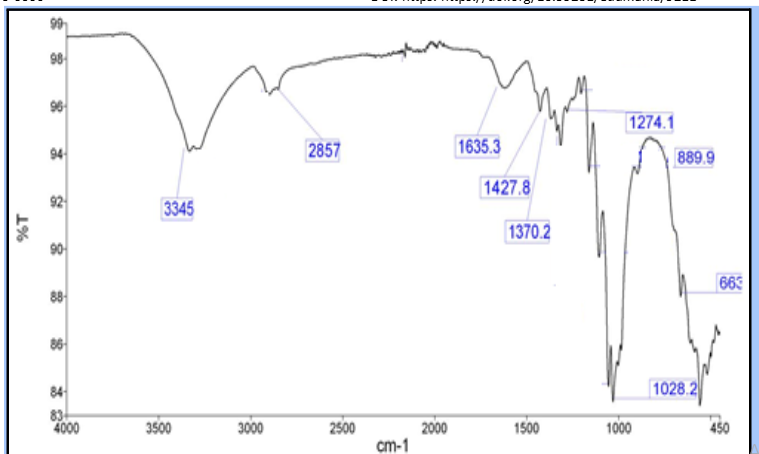
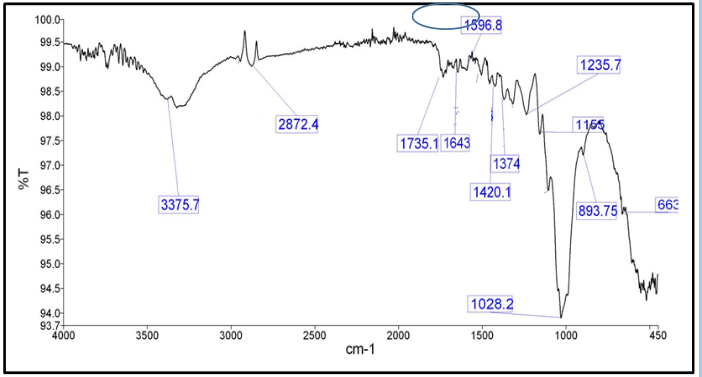
Figure 3: Cotton fiber FTIR

Figure 4: Jute fiber FTIR

3.2 Color Strength Analysis

The K/S values increased consistently with increasing jute content in the blend (Table:2).

Table 2: Cotton/Jute blend Ratio and their K/S value

S.No.

Cotton/Jute Blend Ratio

Color Strength-K/S

(Reactive red Dye)

1

100%Cotton

1.81

2

80%Cotton 20%Jute

1.95

3

60%Cotton 40%Jute

2.30

4

50%Cotton 50%Jute

2.42

5

40%Cotton 60%Jute

2.90

6

20%Cotton 80%Jute

3.70

7

100% Jute

5.40

This trend clearly indicates that blend composition significantly influences dye uptake.

The higher moisture regains and swelling capacity of jute fibers likely enhanced diffusion of reactive dye molecules into the fiber matrix, thereby increasing fixation efficiency and final shade depth (Mishra, S., & Behera, B. K., 2016). Blends containing 60–80% jute exhibited notably higher K/S values compared to cotton-rich blends.

3.3 Statistical Analysis

Univariate ANOVA revealed a statistically significant relationship between blend ratio and color strength. Since the obtained p-value was less than 0.05 (table:3), the null hypothesis was rejected, confirming that blend composition has a significant effect on color strength.

4. CONCLUSION

The present study established that the proportion of jute in cotton–jute blends significantly influences dye uptake and resultant color strength.

All characterization techniques confirmed the identity and structural differences of the selected fibers. The experimental and statistical findings consistently demonstrated that increasing jute content leads to higher K/S values due to enhanced moisture absorption and dye fixation. Blends containing 40% or more jute may therefore be considered suitable for applications requiring improved coloration performance along with sustainability benefits.

Statements & Declarations

Author’s Contribution: The author, Indu Gupta, was responsible for the conceptualization and design of the study, conducting the experimental trials on cotton and jute blending, analyzing the color strength variations, and writing the complete manuscript.

Peer Review: This article has undergone a double-blind peer-review process organized by the Editorial Board of Edumania-An International Multidisciplinary Journal. Independent reviewers with expertise in textile chemistry and fashion technology evaluated the technical accuracy of the fiber composition analysis and the validity of the color strength findings.

Competing Interests: The author declares that there are no financial, personal, or institutional conflicts of interest that could influence the objectivity or integrity of the research presented in this paper.

Funding: The author declares that no specific financial support or grants were received from any public, private, or non-profit funding agencies for this research.

Data Availability: The experimental data regarding fiber ratios and spectrophotometric color strength results supporting the conclusions of this study are included within the article. Any additional technical datasets can be made available by the author upon reasonable request.

Ethical Approval: This study follows the ethical guidelines for academic research in materials science. As the research involves laboratory-based textile testing and does not involve human or animal subjects, standard institutional safety and environmental protocols of the Footwear Design & Development Institute (FDDI) were followed.

License Statement: This work is licensed under a Creative Commons Attribution-NonCommercial-NoDerivatives 4.0 International (CC BY-NC-ND 4.0) License. Published by ICERT.

References
  1. Gedik, G. (2021). Extraction of new natural cellulosic fiber from Trachelospermum jasminoides (star jasmine) and its characterization for textile and composite uses. Cellulose, 28(11), 6899–6915. https://doi.org/10.1007/s10570-021-03952-1

  2. Mishra, S., & Behera, B. K. (2016). Dyeability of jute and its blends with cotton fibers. Journal of Natural Fibers, 13(2), 115–123.

  3. Mittal, R. M., Shah, N. C., Mehta, H. U., & Trivedi, S. S. (1981). Cellulosic blends—Pretreatment processes. In M. Gulrajani (Ed.), Blended textiles (pp. 234–234). Textile Association of India.

  4. Shelar, P. B., & Kumar, U. N. (2021). A short review on jute fiber reinforced composites. Materials Science Forum, 1019, 32–43.

  5. Sfiligoj, M., Hribernik, S., Stana, K., & Kree, T. (2013). Plant fibres for textile and technical applications. In Advances in agrophysical research. InTech. https://doi.org/10.5772/52372

Scroll to Top